
Jelly Truck
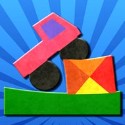
















Jelly Truck looks like a soft, bouncy toy rolling across cheerful cartoon hills, but it plays like a balance puzzle where one careless lean turns your truck into a flat wobble of jelly at the bottom of a pit.
| Genre | 2D physics-based truck driving |
|---|---|
| Levels | 20 |
| Core Mechanic | Soft-body jelly physics, lean and momentum control |
| Controls | Press to drive forward, press again to lean or tilt |
Soft-Body Physics in Jelly Truck
Most driving games treat the vehicle as a rigid shape that bounces or stops on impact. Jelly Truck simulates the whole truck as a soft body instead, so the chassis squishes, stretches, and wobbles depending on speed and the angle you hit something at. That's why the game feels harder to control than it looks — the truck isn't running physics you already know from other driving games, and momentum carries through the jelly body in ways that aren't always intuitive.
New players assume Jelly Truck controls like a normal side-scroller and mash the accelerator through every obstacle.
That works for the first few flat stretches, but once a ramp or narrow gap shows up, holding full speed means the soft body deforms mid-air and lands wrong. Slower, deliberate movement holds up far better than raw speed once the terrain gets uneven.
Leaning and the Jelly Flip in Jelly Truck
Pressing the drive button a second time leans the truck's body rather than accelerating further, and that lean is what players call the jelly flip once it's used to rotate the truck midair after a jump. Landing flat versus landing on a corner makes a real difference in whether you keep momentum or stall out completely. It takes a few failed jumps before the lean feels like a steering tool instead of an accident.
The jelly flip becomes essential on trampoline sections, where bouncing at the wrong angle sends the truck sideways instead of forward toward the next platform. Landing the lean just before the bounce keeps momentum pointed the right way.
Once you're landing flips consistently, that same lean control carries over to Jelly Truck's collapsing jelly bridge sections, where the bridge sags and breaks apart the longer your truck's weight sits on one plank. Crossing quickly, without lingering long enough for a plank to give way, is one of the clearer skill checks in the level list.
Level Design Across Jelly Truck's 20 Stages
With 20 levels total, Jelly Truck moves from flat, low-obstacle stretches into courses built around pits, tall walls, sharp turns, and cliffs. Later stages stack hazard types together — a swinging pendulum right after a wide gap, for instance — so skills from earlier levels get tested in combination. The jump from the early stages to the mid-game levels is sharp enough that plenty of players hit a wall once pendulums start showing up.
Camera awareness starts mattering here too, since tight courses make it easy to misjudge exactly where the truck's edges sit relative to a wall or ledge. Repositioning the view before a tricky jump costs nothing.
What keeps the later levels from feeling unfair is that the soft-body physics stays consistent. The truck behaves the same way it did on level one, just against harder terrain, so the learning curve is about reading the course rather than fighting new rules.
Shortcuts and Alternate Routes in Jelly Truck
- Several levels include a visible alternate path — usually a higher ledge or a gap in a wall — that skips a chunk of the course if you can reach it with enough speed.
- Finding these routes usually means intentionally overshooting a jump instead of aiming for the safe landing, which runs against the slow-and-controlled habit the rest of the game teaches.
- Not every level has one, and the ones that do rarely mark them clearly, so most players only find them by accident on a replay.
That tension between playing it safe and taking the shortcut is one of the more divisive things players bring up about Jelly Truck. The shortcuts are satisfying to find but inconsistent enough across the 20 levels that relying on them isn't really a strategy, just a bonus when it happens.
Some players ignore them entirely and just focus on clean, controlled runs through the main path, which is enough to clear every level on its own. That's arguably the steadier way to finish Jelly Truck's harder stages.
Either way, the shortcuts don't change what the level is actually testing: control of the soft body under momentum. They just offer a faster route through it for anyone willing to gamble a jump.
Jelly Truck never stops being a game about one soft, wobbling shape reacting to gravity and momentum. Whether you're crossing a collapsing jelly bridge plank by plank or gambling on a shortcut past a swinging pendulum, that same soft-body logic is what the whole 20-level course is built around.