
Geometry Dash Scratch














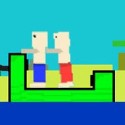
Open Geometry Dash Scratch and you start at the same place every run: a small square on flat ground at the left edge of the screen, a wall of spikes and gaps ahead, and a soundtrack already counting you into the first jump. Nothing about that starting position changes no matter how far you got on the previous attempt.
| Genre | Rhythm platformer |
|---|---|
| Built On | Scratch (scratch.mit.edu) |
| Input | Click or key press to jump |
| Platform | Browser |
Timing a Jump in Geometry Dash Scratch
The whole game reduces to one input, a click or key press to jump, but the difficulty comes from how tightly that lines up with the music and the obstacle ahead. Because this runs on Scratch, the block-based platform built by MIT, the logic behind each obstacle is something anyone can open and inspect, part of why the format has been rebuilt so many times by different creators.
New players consistently misjudge the spacing between obstacles, jumping the instant they see a spike rather than reacting to the rhythm underneath it. Most deaths happen a beat early rather than late, since overcorrecting for a spike you almost hit tends to cause the very death it was trying to avoid.
The difficulty curve inside a given remix tends to escalate through tighter spacing rather than new mechanics. A level manageable in its opening stretch can turn unforgiving a few spikes later without a single new rule being introduced.
Why Remixing Is Central to Geometry Dash Scratch
Because Scratch projects can be opened and forked by anyone, the wider scene is built almost entirely out of remixes: community members taking an existing cube-and-spikes project and changing its layout, cube color, or music sync before sharing it back out. Quality varies wildly from one remix to the next; a project aligned to its music plays nothing like a rushed one that just swapped a background.
- Players who enjoy tinkering as much as playing gravitate toward opening the code behind a level to see how a spike pattern was scripted.
- Players who just want a clean run check a remix's love and view counts first, since a heavily remixed project with almost no engagement is usually unfinished.
The most honest criticism of the format is that physics and hit detection vary between remixes, since each is built independently rather than sharing one tuned engine. A jump that feels precise in one version can feel floatier or stricter in another, so skill built on one project only partially carries to the next.
That's why sticking with one favorite remix as a main version tends to pay off. The physics stop moving under you once you've settled on a single project instead of hopping between several.
Do you need an account to play Geometry Dash Scratch projects?
No account is required just to play. One is only necessary to save your own remix or leave a comment.
Why does a level sometimes lag?
Lag usually comes from how the individual project was coded rather than from Scratch itself. Dense obstacle scripting runs heavier than simpler remixes, which is why two similar-looking projects can perform very differently.
Can you change the cube's appearance?
Many remixes let you swap the block's color or icon. That's one of the most common changes creators add when forking an existing project.
Geometry Dash Scratch turns a single jump input into a genre's worth of variation once you start comparing one cube-and-spikes remix against the next, and the gap between a carefully tuned project and one thrown together in an afternoon is obvious within the first few spikes.